
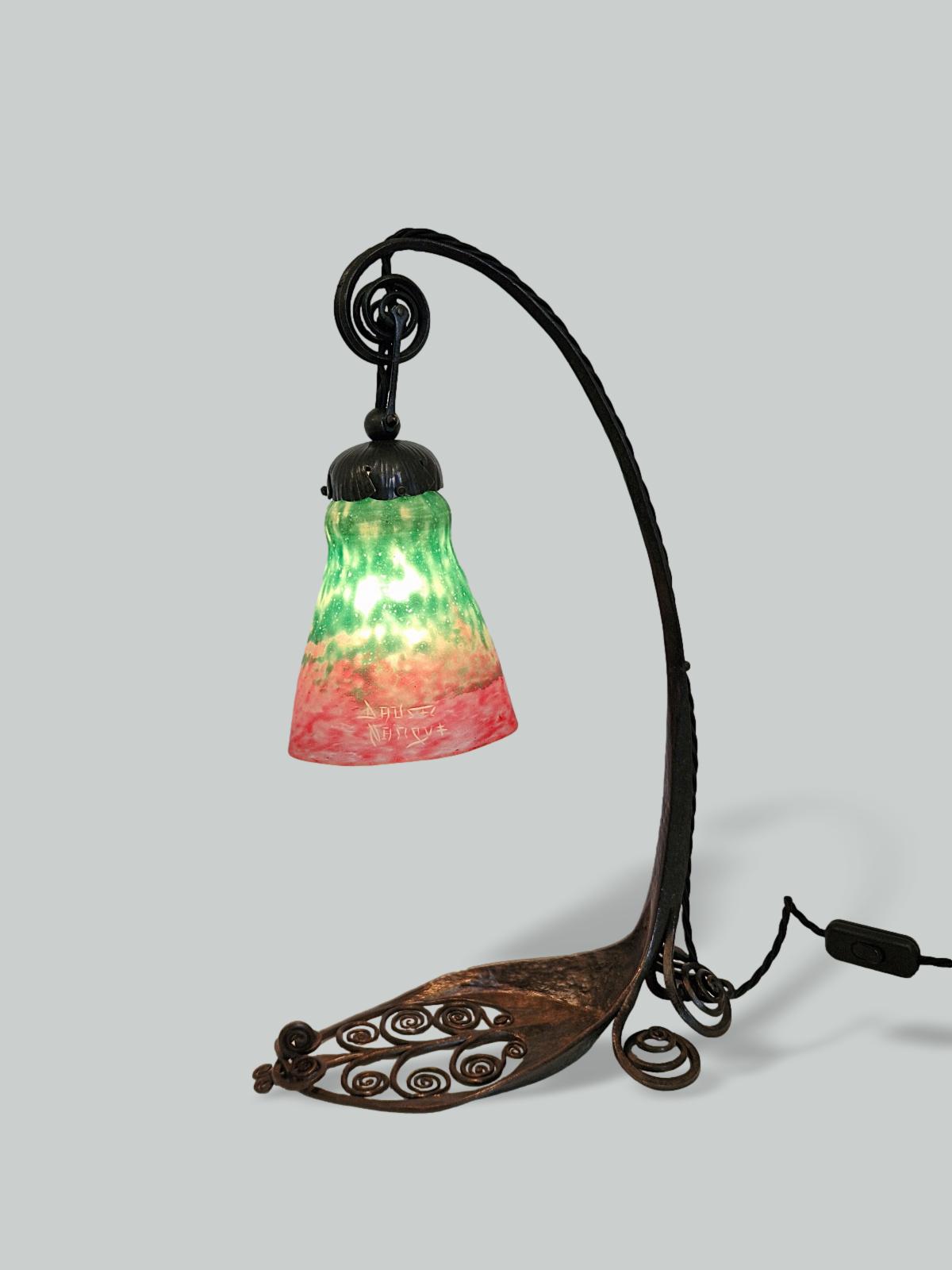
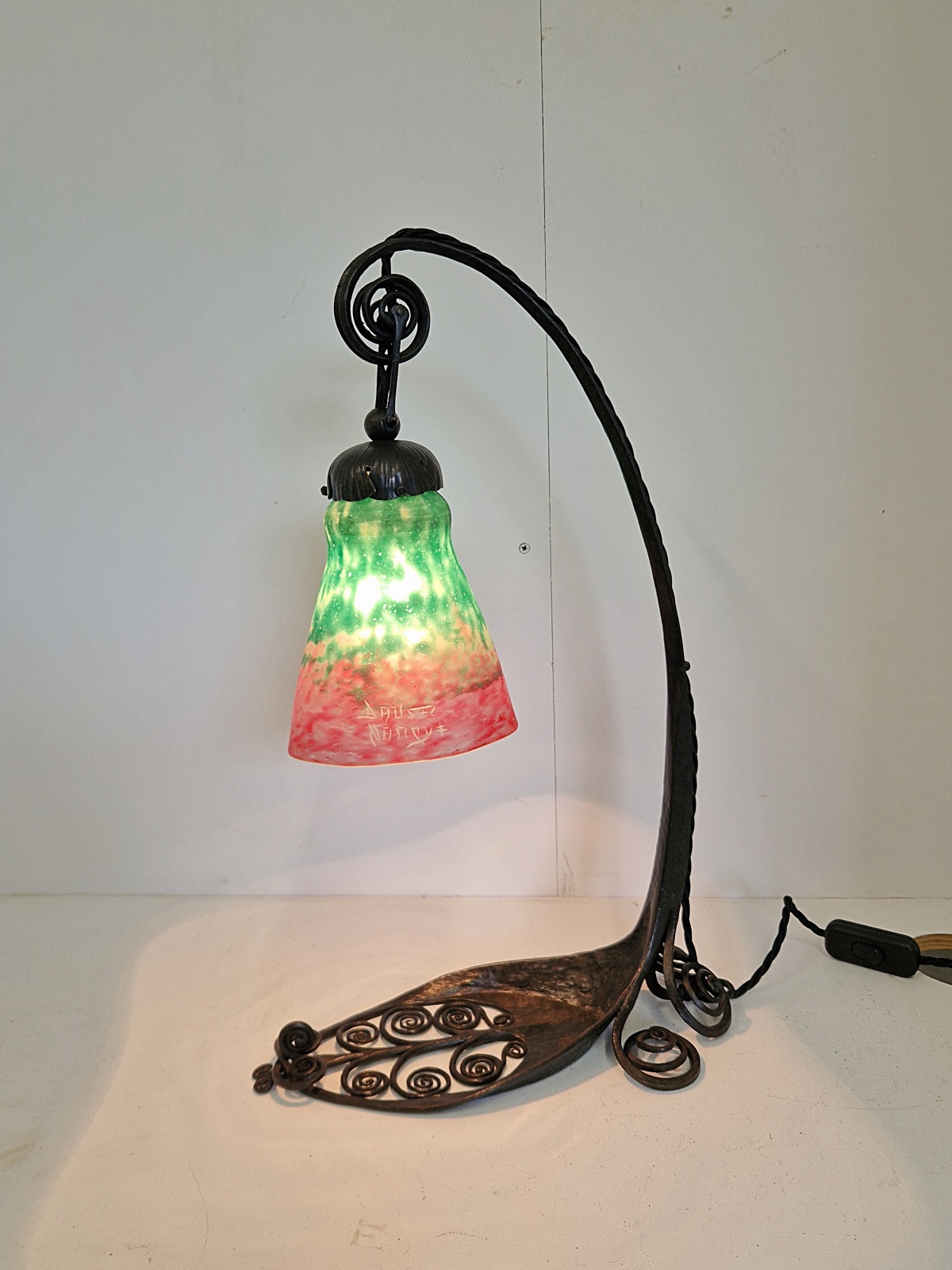
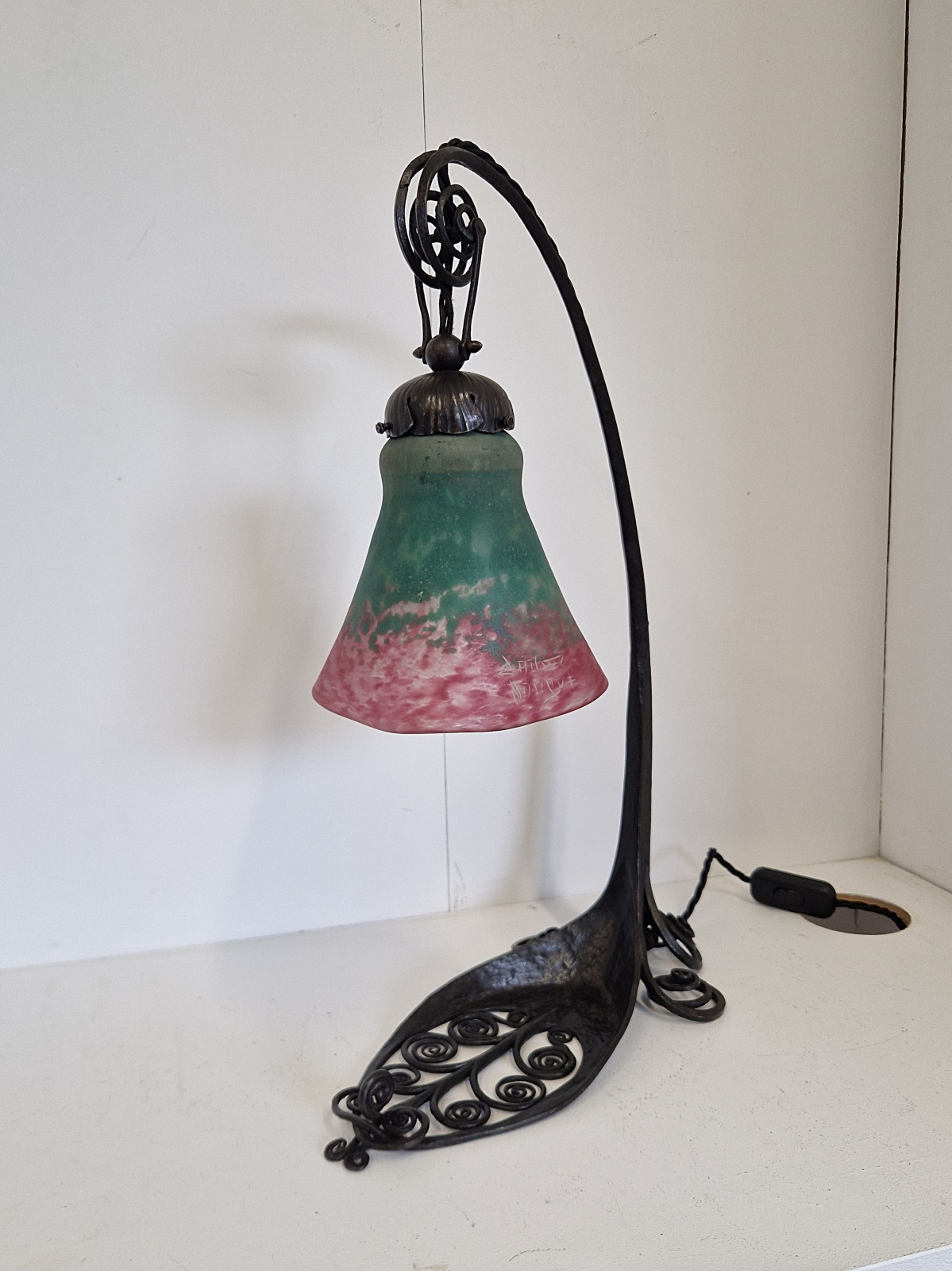
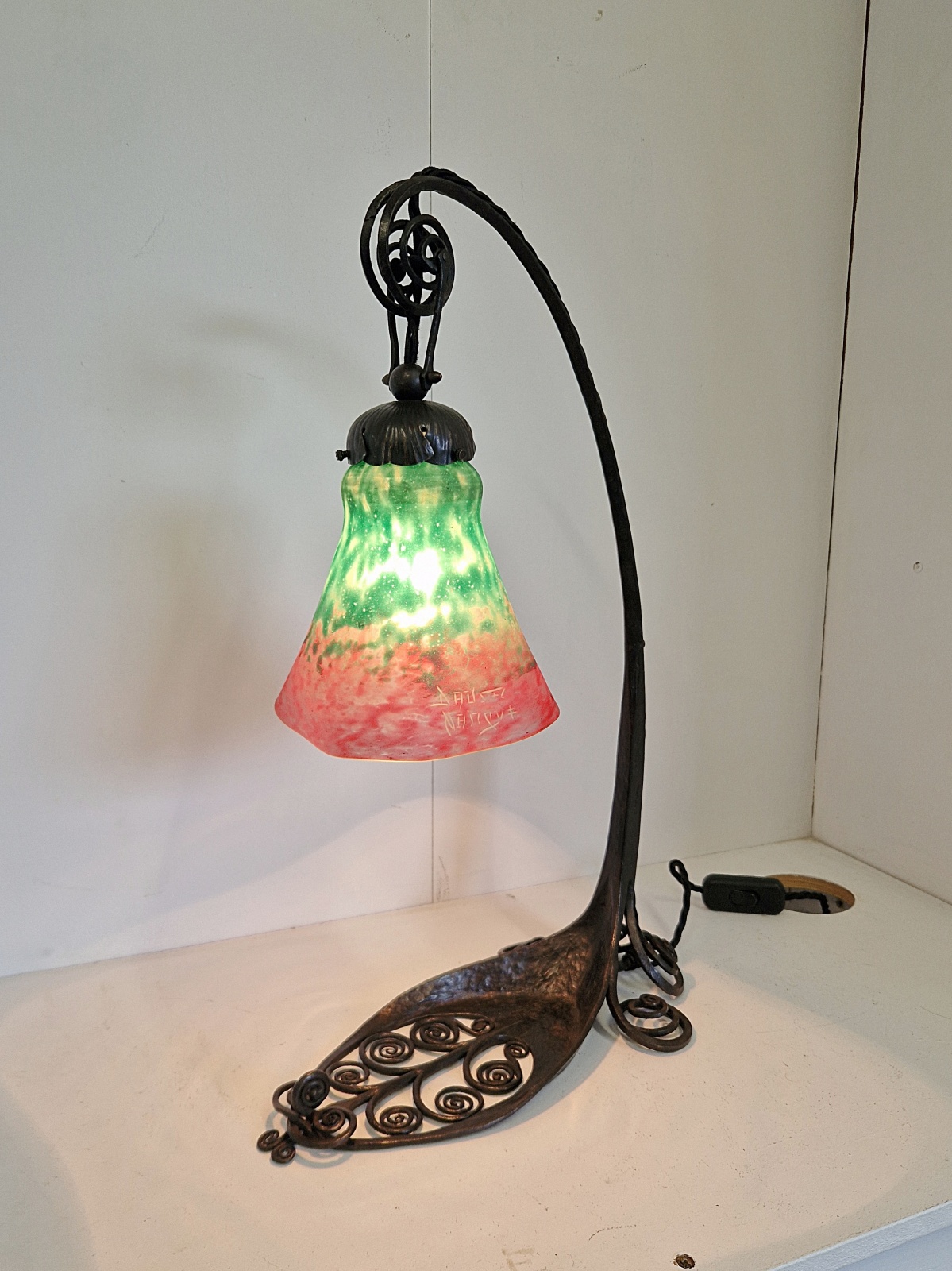
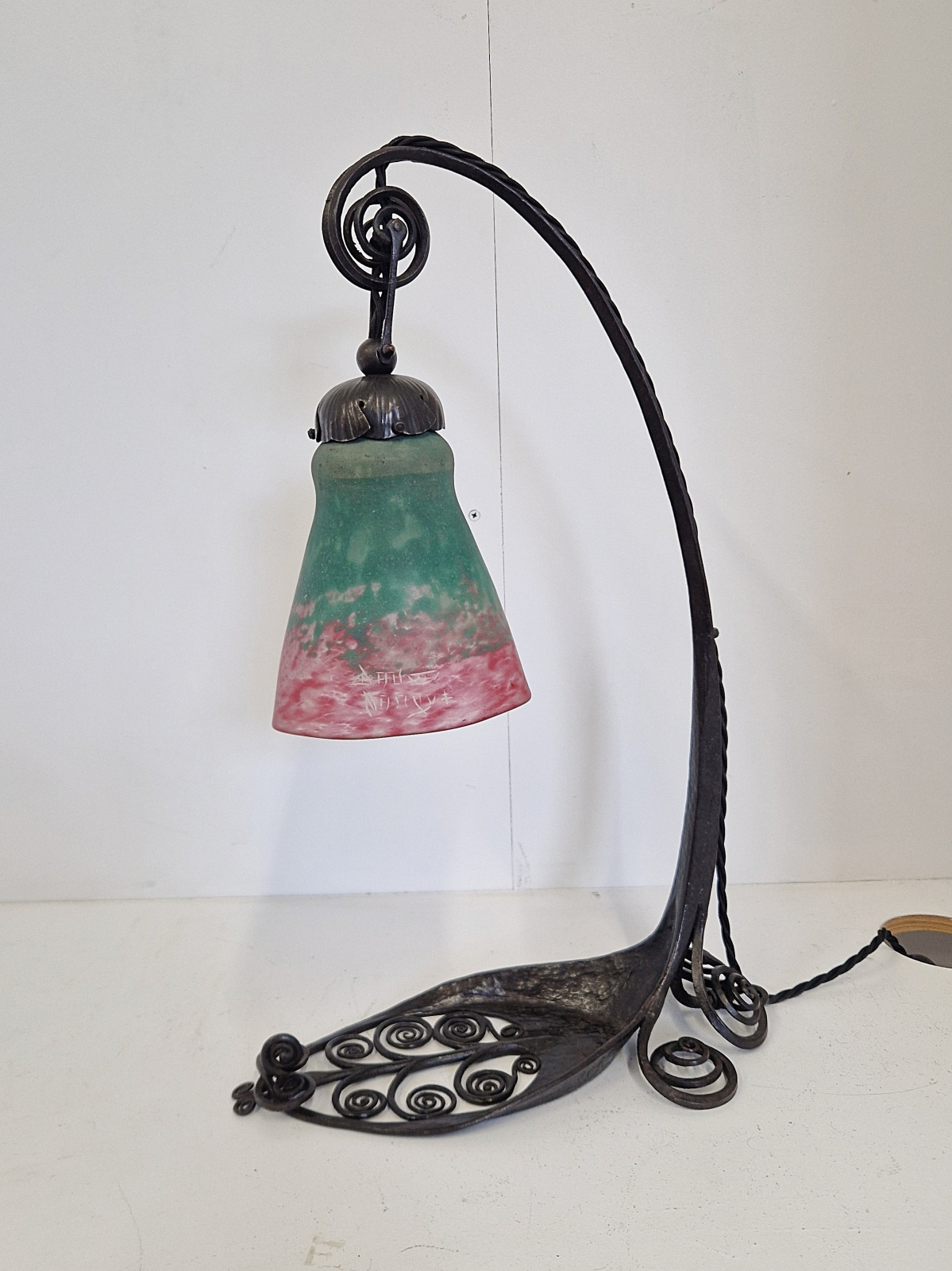
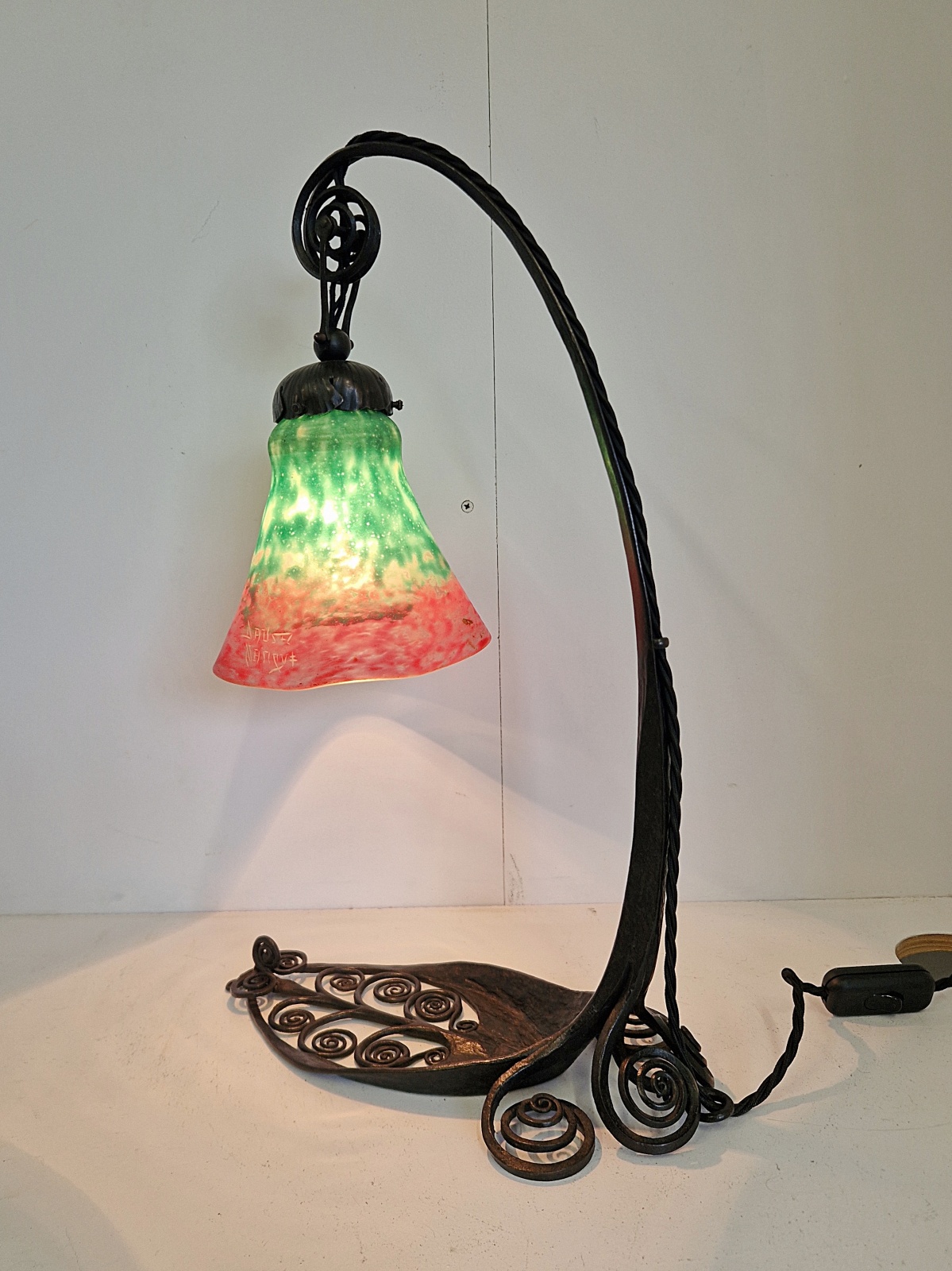
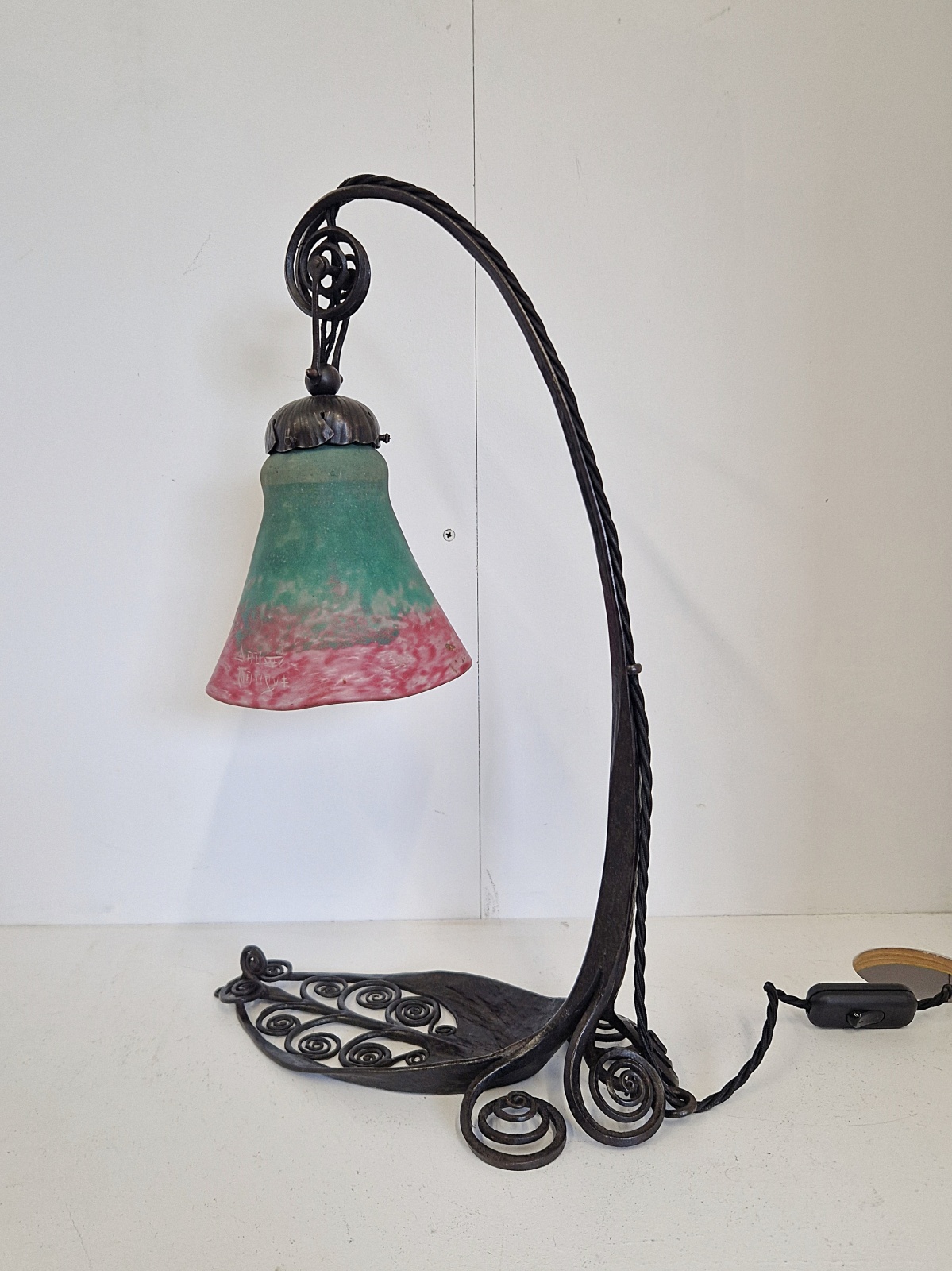


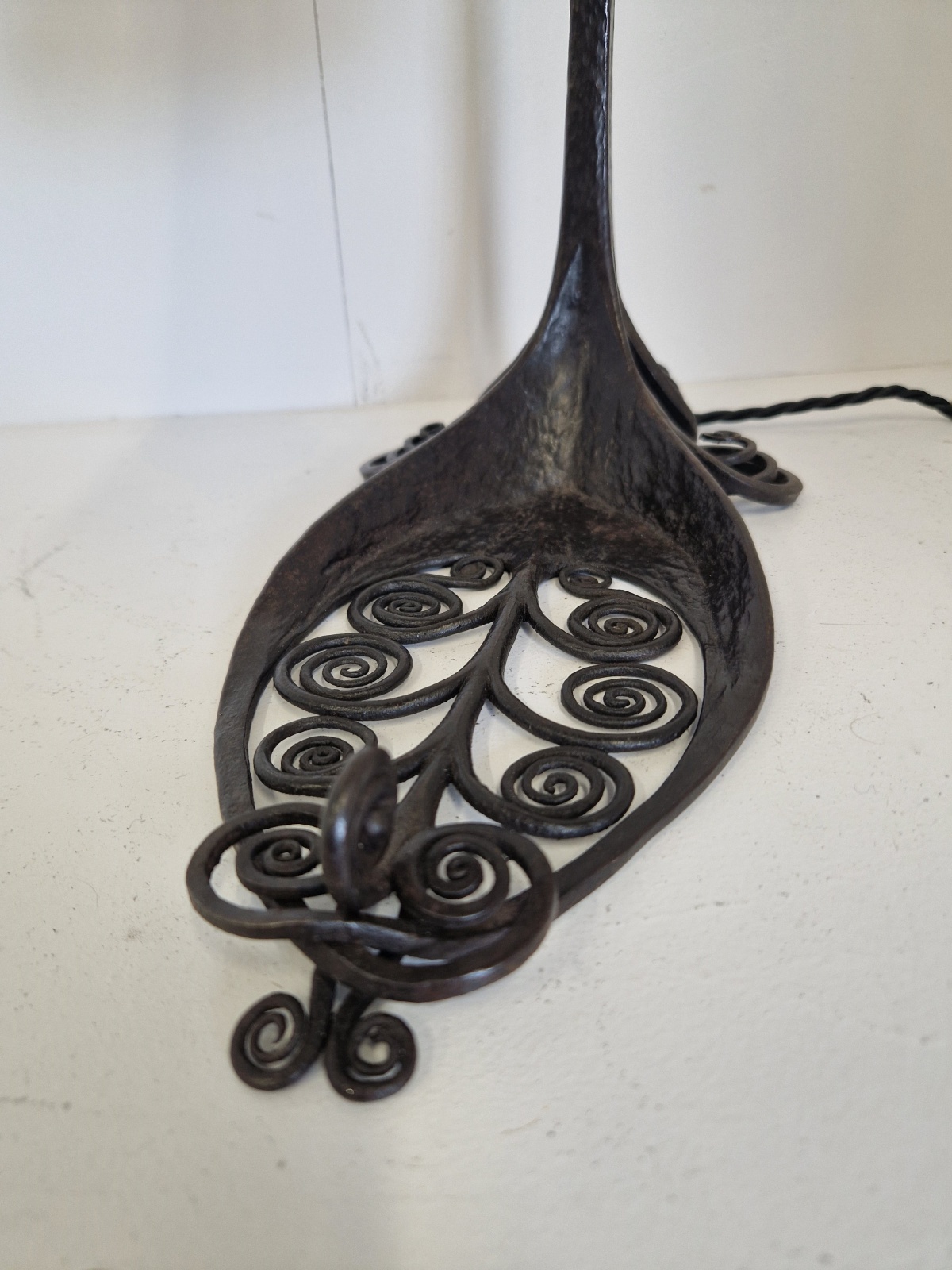
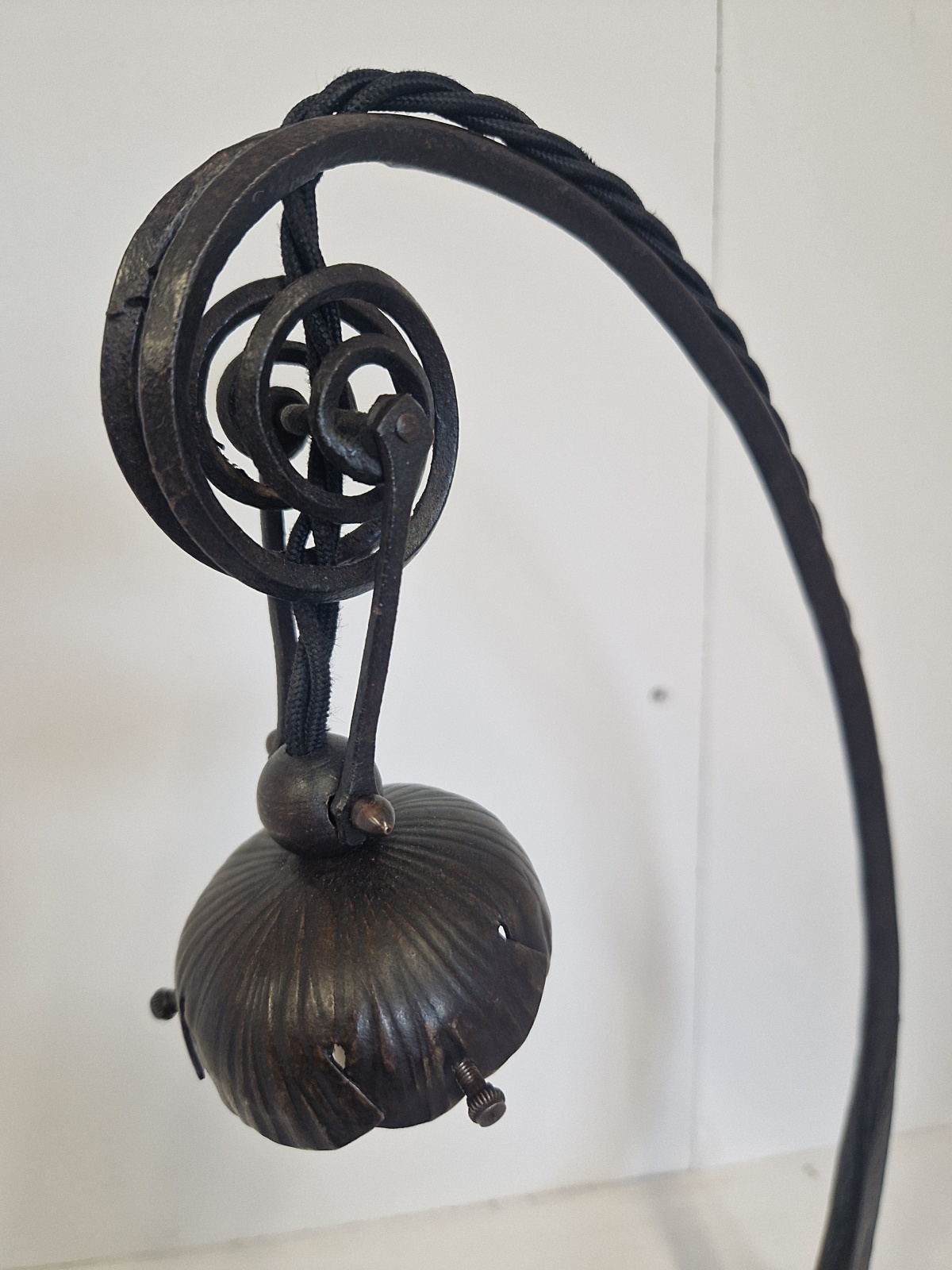
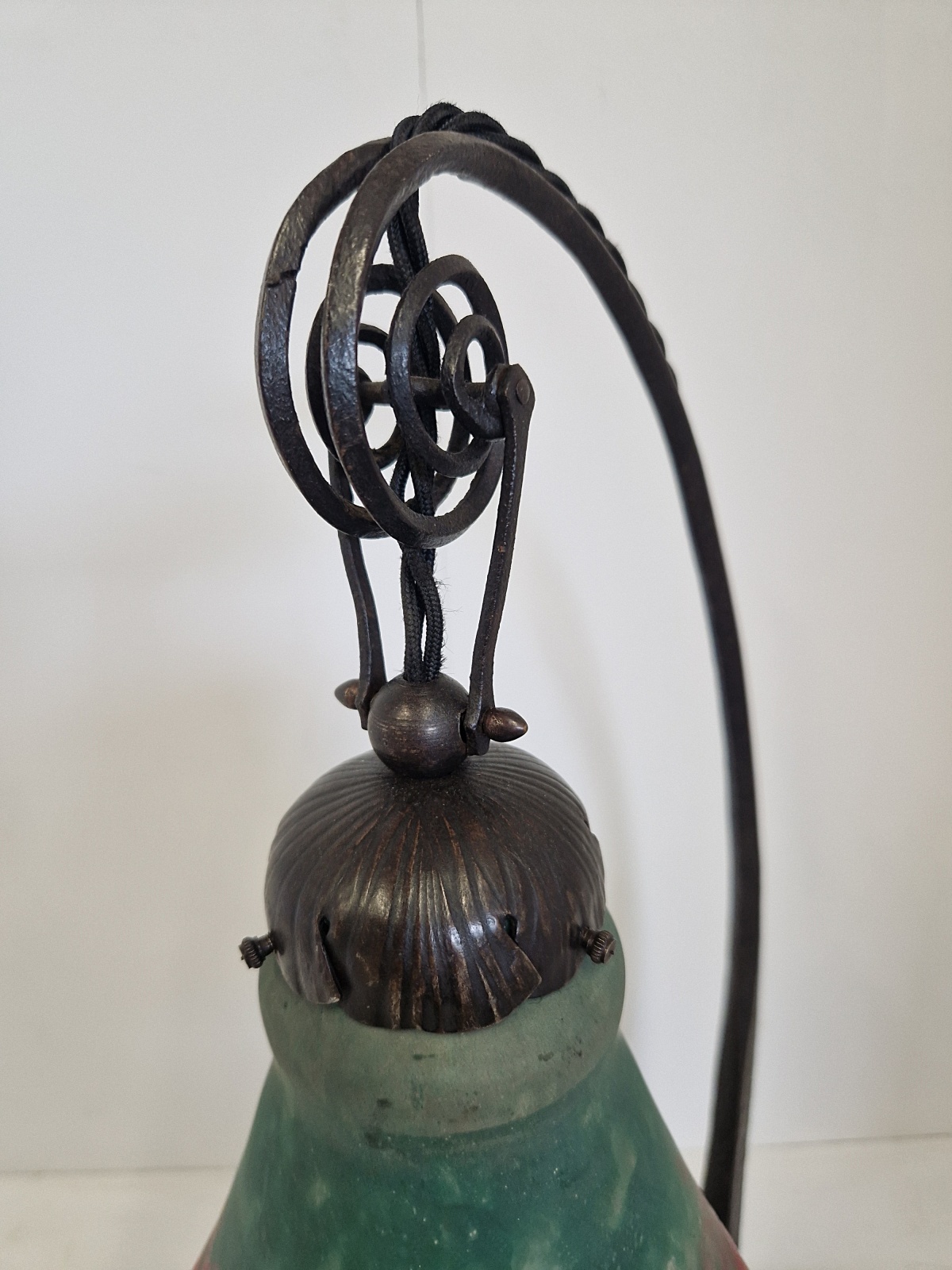
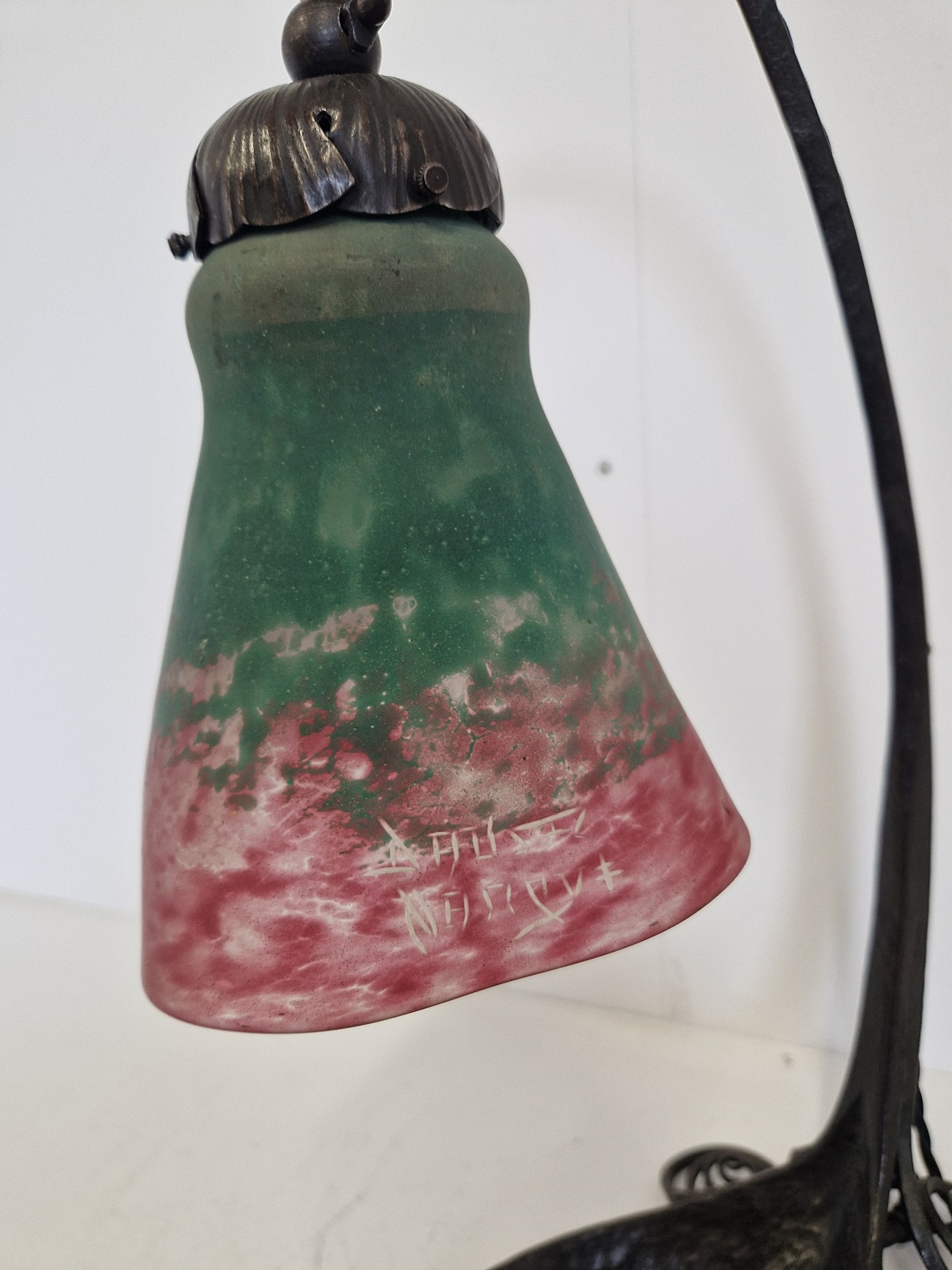
Attributed Edgar Brandt with Daum Frères | Wrought-iron and Pate-de-verre Desk Lamp | France c.1920-30
£3,495.00
Product Code: LG758PDV024This signature wrought iron desk lamp is attributed to Edgar Brandt and hand-crafted to the utmost high quality but remains apparently unsigned. From the intricate and highly delicate wrought iron fronds to the bespoke bearings for the swivel mechanism on the shade gallery this piece has a remarkable design throughout and leaves us in no doubt is the work of the master artisan. The base is complemented with an equally beautiful pate-de-verre lampshade in strong mottled tones of green & red. Signed “Daum, Nancy” with the Croix de Lorraine. France c1920-30
Dimensions / Specifications:
- Ht. 49cm/19in, Ht.(shade)14/5.5, W.(shade)13/5, W.(base)15/6, Dpth.(base)29/11.5
- Supplied with 2m flex and 13amp plug
Not Included:
- 1 x B.22 (4 or 6w) L.E.D candle or golf bulb (Available to purchase in our accessories department)
Edgar Brandt, Paris 1880-1960
- Edgar Brandt is considered the premier French metalsmith of the early 20th century and a visionary and is world-renowned as a master of Art Deco ironwork.
- He was one of the first to master the oxyacetylene welding torch (invented in 1903), which allowed him to create intricate, lace-like metalwork that was impossible with traditional riveting.
- 1894–1898: Attended the École Nationale Professionnelle de Vierzon. He excelled in ironwork and precision mechanics, which became the foundation for his later success.
- 1901: Opened his first workshop in Paris at 76 rue Michel-Ange, initially producing small wrought-iron jewelry and ornaments.
- 1903: Made his debut at the Salon des Artistes Décorateurs (SAD), showing early Art Nouveau designs.
- 1925: The pinnacle of his artistic career at the International Exposition of Modern Decorative and Industrial Arts in Paris where his designs became synonymous with the “Style Moderne”
- 1926: Opened his flagship gallery/showroom, Etablissements Brandt, at 101 Boulevard Murat in Paris.
- 1926: Opened Ferrobrandt on Madison Avenue in New York City, introducing the Art Deco style to the American market.
- Brandt collaborated with Daum Freres, Nancy to provide the glass for his lighting although there is no documentation to say this was an exclusive arrangement.
Daum Frères, Nancy
Auguste (1853–1909) & Antonin (1864-1931)
- The famous Daum glass factory dates back to 1878 when Jean Daum a lawyer with no glass-making experience, took the Sainte-Catherine glass-works in Nancy as payment for an outstanding debt.
- His sons, first Auguste & later Antonin, became partners in the business, August (Manager) in 1879 and Antonin (Art Director) in 1887.
- Antonin trained as an engineer and artist, he founded the glassworks art department in 1891 and oversaw all creative output, innovating with techniques like cameo glass and acid etching.
- In 1893 they debuted their “Daum Nancy”art glass at the Chicago World’s Fair, establishing their signature and international reputation.
- 1900: Achieved their ultimate triumph at the Paris Exposition Universelle, winning a Grand Prix. This victory allowed them to step out of the shadow of their rival, Émile Gallé.
- 1901: The École de Nancy (Nancy School) is founded by Émile Gallé (president) with Antonin Daum and the furniture maker Louis Majorelle serving as vice presidents.
- 1904: Following Gallé’s death, the Daum brothers became the de facto leaders of the École de Nancy and the global decorative glass market.
- 1920s: Under Paul Daum (Auguste’s son), the company successfully transitioned from Art Nouveau to Art Deco, moving away from floral motifs toward geometric forms and thick, acid-etched glass.
- Lighting was in its infancy as an art form and Daum collaborated with designers of metalwork such as Edgar Brandt and Louis Majorelle to produce creations of appropriate verve and originality.
- Daum along with Gallé are now considered the premier French glass designers of the era.
Related Products
-
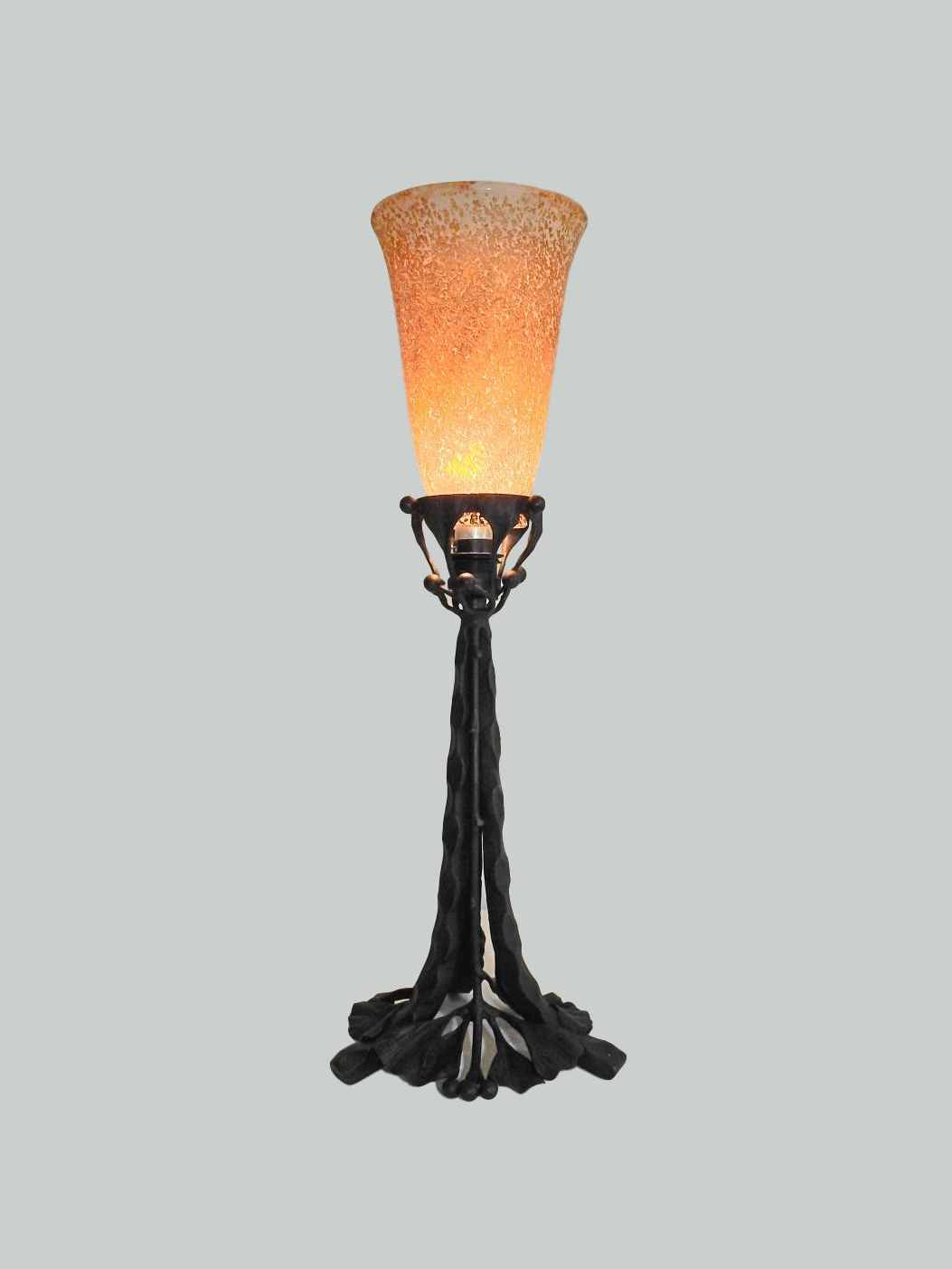
Daum Fréres, Nancy | Wrought-iron and Pate-de-verre Table Lamp | Fr...
Product Code: JAL1004LG462 £995.00 Add to basket -
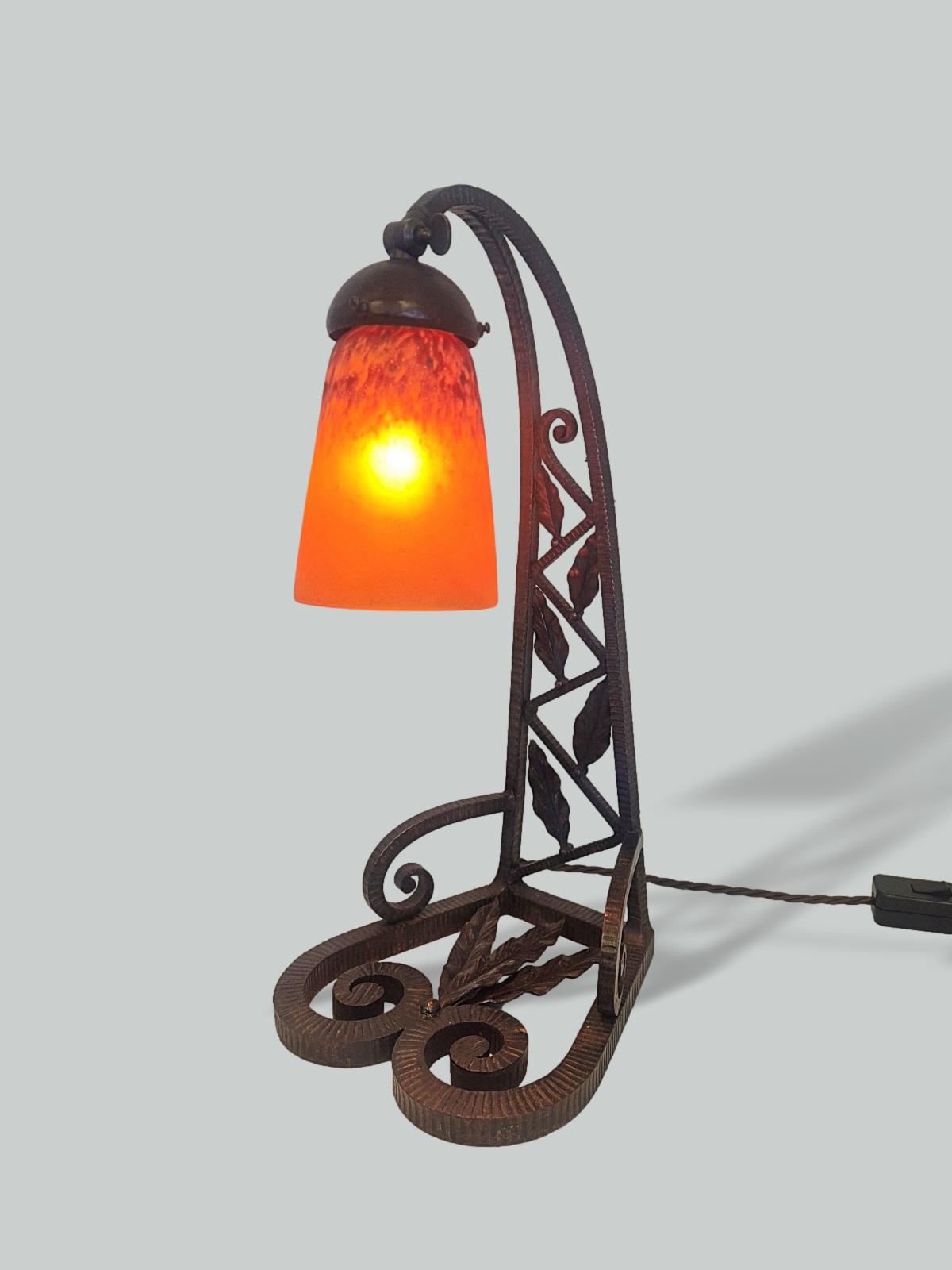
François Carion & Verreries Schneider | Wrought-Iron Desk Lamp...
Product Code: JAL1304LG420 £1,595.00 Add to basket -
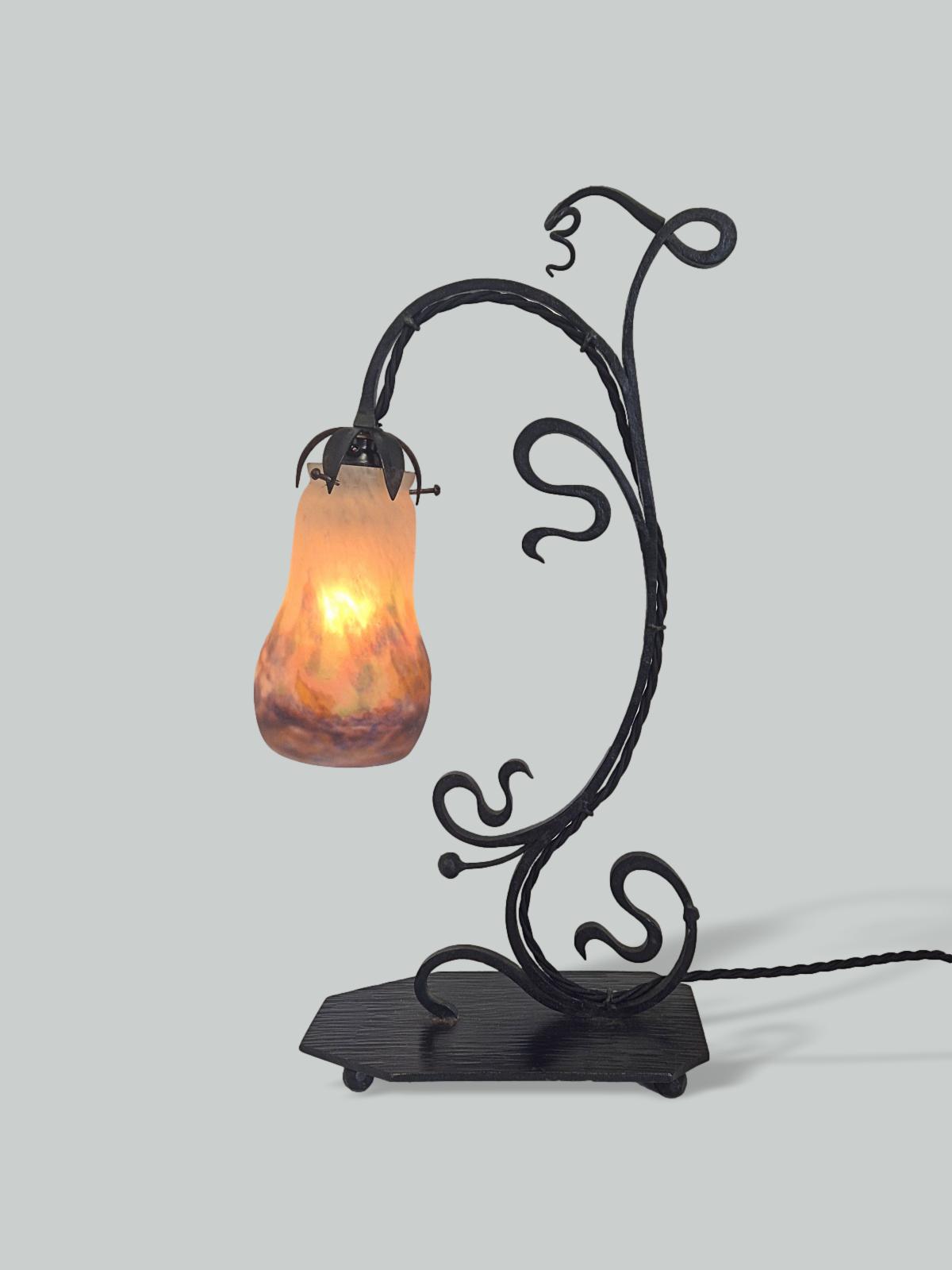
Muller Frères, Luneville | Wrought-iron Table Lamp | France c.1920-30
Product Code: JAL0078 £595.00 Add to basket